
When it comes to bridal fashion, there is only one person whose advice I council time and time again. My lovely friend Jo at JULITA is a true visionary. She is creative, kind, considered and truly loves making women feel their absolute best.
With wedding dress hunting season upon us, and Bridal Fashion Week imminent, I asked Jo some questions that I thought might be pertinent. Finding your wedding dress can be an overwhelming process, so I hope Jo’s answers will help you find a dress that makes you feel incredible.

Could you explain what dresses are being shown at Bridal Week, in NY and Barcelona? Do designers create two collections a year? When do these dresses come into stores?
At Bridal Fashion Week, the world gets its first glimpse of what is to come, collections filled with fresh direction and the mood of the season. Many designers present two collections a year, echoing Spring / Summer and Fall / Winter rhythms. These gowns typically arrive in boutiques a few months later.
But not every designer works in this way. At JULITA, I create at a slower pace – more intuitively. Sometimes it’s a small capsule of new pieces. Sometimes a single idea stirs something, or a bride brings a need we hadn’t yet imagined. It’s not tied to trends or deadlines; it’s a quieter, more natural unfolding.
If you love a specific designer, should you go directly to their bridal store or via your local stockist?
If a designer has their own studio or showroom, that can be a beautiful way to experience the full depth of their work, often with more opportunity for bespoke touches or variations.
But local stockists also hold their own kind of magic. They’re often deeply in tune with the women they serve.
I always suggest exploring both, if you can. Meeting a designer or even simply being in touch through a boutique can spark something really special. A shared vision. A collaboration that makes your dress feel uniquely yours.
Both offer something meaningful.
If a local store offers the designer a bride likes, will they be able to try on every gown from their latest collection?
Not usually. Boutiques tend to curate – choosing gowns they feel best suit their brides, their space, and their style.
But if there’s a particular gown you’ve seen and fallen for, always ask. Sometimes a boutique can borrow it in, especially during trunk shows or special events. It’s always worth enquiring!
What is the process for ordering a bridal gown? What is the difference if you go for a bespoke dress?
For a made-to-order gown, you’ll try on a sample, choose your size, and the gown is then made for you in that standard size. You’ll likely need some tailoring to ensure it fits perfectly – those alterations are an extra cost and worth factoring in from the start.
As well as made-to-order JULITA offers customised made to measure, which is a blend of personal and considered. Maybe you love the neckline from one gown and the skirt of another. We combine what you love and create a piece just for you, cut to your own measurements.
We also offer exclusive bespoke couture. This is where we begin with a blank page – a sketch, a feeling, a story. Every element is shaped around you. It’s more than a dress – it’s a conversation, a collaboration, a memory in the making.
If a bride falls in love with a dress from an older collection, can she still have this made?
Yes! My past collection samples are kept – patterns, notes, details archived and ready to be reawakened. If a fabric is no longer available, we’ll find something else that speaks – sometimes even more deeply.
There is something quietly powerful about revisiting a piece from the past and making it your own.
Designers with large made-to-order collections will often keep a core range of their best-selling styles as samples so you can shop their archive too.
Where are dresses made? Are they made in the UK or overseas? Does this depend on the designer?
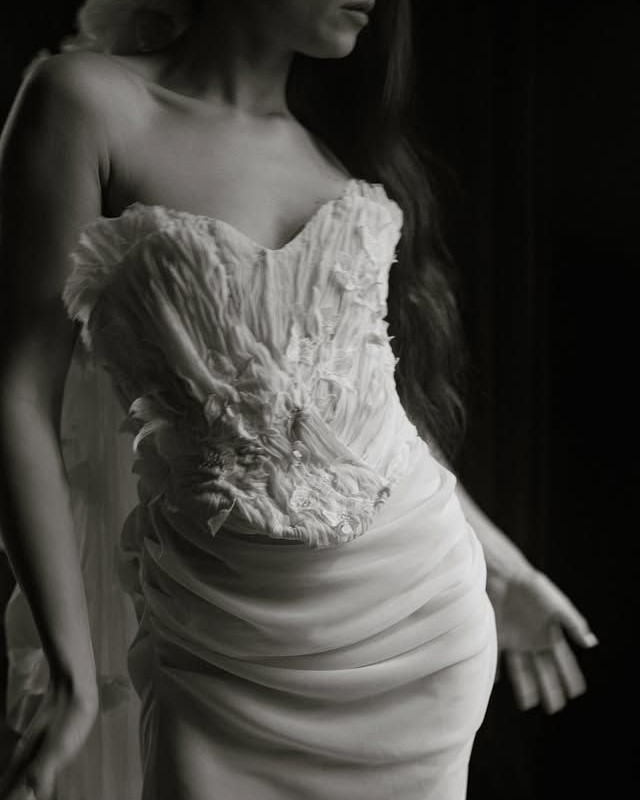
This varies hugely depending on the designer. At JULITA, every gown is handmade here in the UK – thoughtfully, carefully, and in close collaboration. Each dress passes through only a few hands, allowing for deep attention to detail and space to adapt along the way.
Larger bridal brands often produce overseas, which allows for more affordable price points.
It’s so important that your dress is made ethically. That the people behind it are paid fairly, that their skill is respected, and that the process holds the same integrity as the final piece.
To me, a beautiful dress should be beautiful in its making, not just its appearance. Ask questions. Seek honesty. The story behind your dress can be just as meaningful as the one you’ll live in it.
How long will it take for the dress to be made? From ordering it in-store to it being ready for collection?
For made-to-order gowns, the process usually takes 6 to 8 months. This gives time for fabrics to be sourced, the gown to be cut and sewn, and small refinements to be made with care.
Bespoke gowns take a little longer, usually 9 to 12 months, as they involve design development, toiling, and more fittings. Starting early gives the gift of flow – space to explore, breathe, and let the gown become what it’s meant to be.
What kind of fabrics are the norm for bridal wear? What is comfortable to wear all day?
Bridal fabrics are as varied. You’ll find silk satins, chiffons, tulles, laces, organza, and more intricate materials – beaded overlays, embroidered tulles, hand-embellished silks. Each one has its own weight, flow, and presence.
I’m drawn to fabrics with movement and texture – for gowns that feel soft, yet gently sculpted. Whether it’s the drape of a textured silk, or the subtle weight of delicate handwork, it’s all about how the fabric feels when worn.
Fabric composition matters too. Some gowns are made from polyester blends, which are more affordable but often less breathable (and less kind to our planet). Natural fibres like silk or cotton breathe better, feel more luxurious, and many brides are now seeking sustainable, vegan, or recycled options – from deadstock silks to gowns made with fibres spun from plastic bottles or vintage fabrics.
There’s so much beauty in giving new life to what already exists.
Comfort matters. Not just physically, but emotionally – how free you feel and how present.
Where to even begin? What would be your advice if someone has absolutely no idea where to start?
Start with feeling.
Start a mood board. Let it be loose, even chaotic. Collect what moves you – a sleeve, a fabric, a moment from a film, a silhouette from an old photograph. You don’t need to know why you love it, only that you do.
Then go gently into a few thoughtful boutiques and visit designers. Try shapes you hadn’t imagined. Let yourself be moved.
You don’t need to know what you want. You only need to recognise how you want to feel. Because in the end, the right gown isn’t about impressing anyone – it’s about remembering who you are, and dressing from that place.

Thank you so much to Jo for her thoughtful advice.